When fundamental aspects of a system are changing fast and at once, it becomes difficult to see clearly what is actually going on. In such cases, abstraction can give us some distance: construct a model outside the immediate context, explore its implications, and then bring it back to reality to see what it reveals.
I’ll use prime numbers as a mathematical analogy to explore what all of this might mean for the future of work. The math itself is simple; it’s really just a different way of looking at the problem.
Think of anything valuable as a number. A glass of water might be 72, getting a taxi to work 1035, and using a browser to read this blog 7041. The numbers themselves don't matter. What matters is that something complex can have a representation we can operate on.
This isn't entirely imaginary. Word2Vec gave us an early demonstration that numerical representations could preserve meaningful relationships between words, and modern language models have shown how far this idea can go. Meaning, concepts and relationships can be represented numerically and operated on mathematically.
But we can leave all of that complexity behind and make the model much simpler.
Take the world of whole positive numbers: 1, 2, 3, 4, 5… and all the way to inifinity.
Within it, prime numbers such as 2, 3, 5, 7, 11... are special. Using these primes and multiplication, we can generate every whole number (greater than 1) for example:
12 = 2 × 2 × 3
30 = 2 × 3 × 5
There are infinitely many primes, and through composition they generate the entire space.
This captures something I find beautiful in mathematics, and more generally in the idea behind Borel sets: an enormously rich space can emerge from a relatively simple foundation and a small set of operations.
For what follows, though, all we really need is:
A world. Primitives. Composition.
Now let's bring this imaginary world back to ours.
To produce a cup of coffee, let's call it 1155, we need a cup 3, coffee beans 5, hot water 7, and some specific labor 11:
1155 = 3 × 5 × 7 × 11
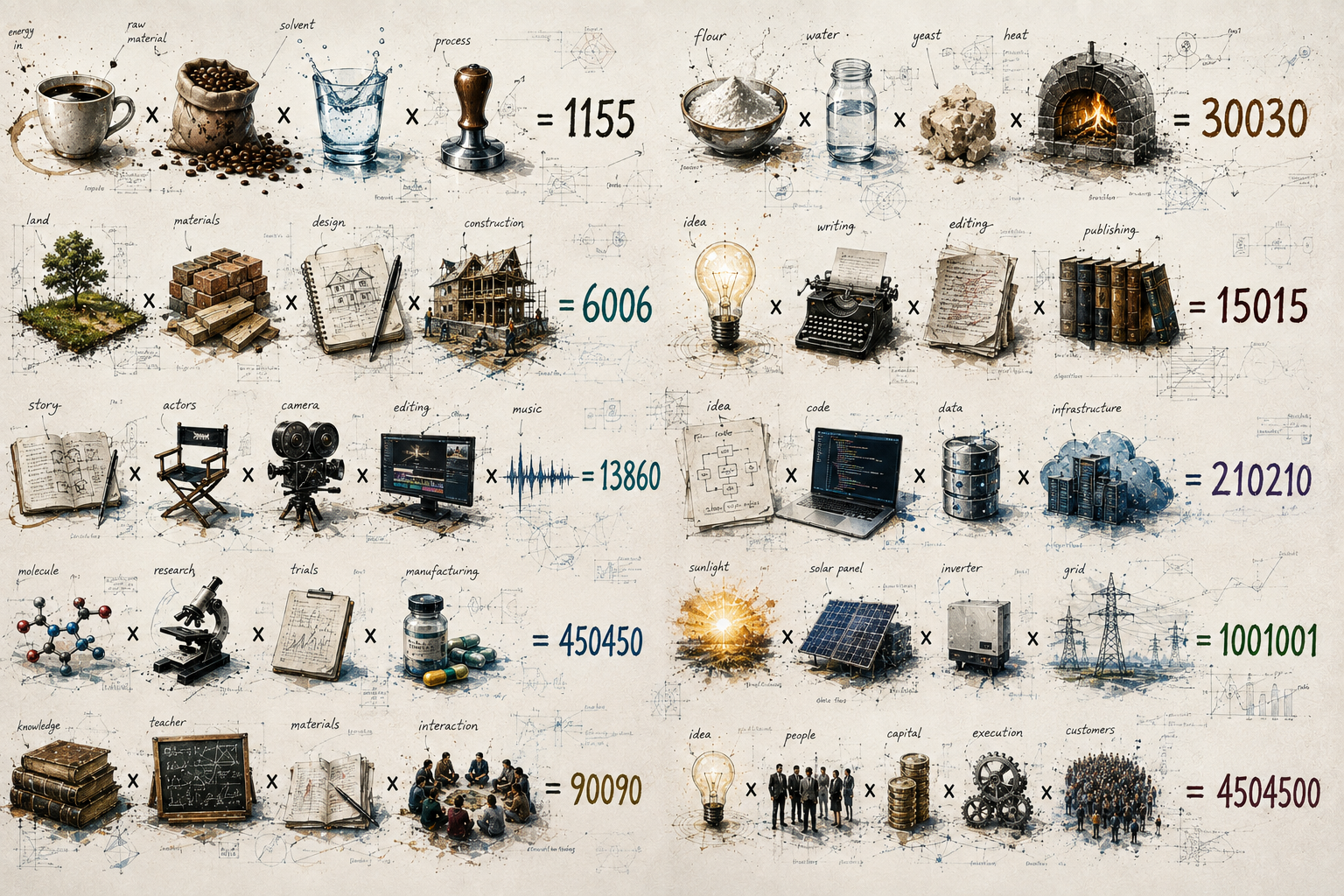
For most of our history, we were heavily involved on both sides of this equation. We discovered or created the building blocks, and then we did the work of combining them into something useful.
Something fundamental is changing.
Technology can increasingly operate directly on the expanding digital representation of our world. Anything with a digital footprint can potentially be accessed, reproduced, transformed, combined with other representations and scaled at very little marginal cost.
Take something arbitrary: a website for hotels for pets. Let's call it 10023. Today, it can begin as little more than an idea expressed in words, while much of the outcome is composed from building blocks that already exist digitally.
The important change isn't simply that building a website became cheaper. As more of the world becomes digitally represented and available for composition, the number of things that can be composed grows enormously.
And when something that used to be expensive becomes cheap, value tends to move somewhere else.
That is the idea I want to explore.
If you want the short version, it is roughly this:
Find your primes. Make sure they're useful. Get unusually good at them. Keep discovering new ones. Don't delegate the work that develops them. Make them accessible. Then let technology multiply them.
There are several ideas packed into that statement. I’ll unpack them one by one, starting with where value moves when composition becomes cheap.
Value Creation: In order to create actual value in the world ahead, we will need to provide a digital footprint for a unique (prime) aspect of life.
This requires both discovering something worth adding to the world and making it available for composition. As more of what already exists becomes digitally represented, it can increasingly be composed, transformed and multiplied, making another composition of existing elements less scarce.
This doesn't mean composition stops creating value. New combinations can still be useful, beautiful or commercially successful. But as composition becomes abundant, differentiated value moves toward what remains scarce: new building blocks that can enter the system and become available for composition.
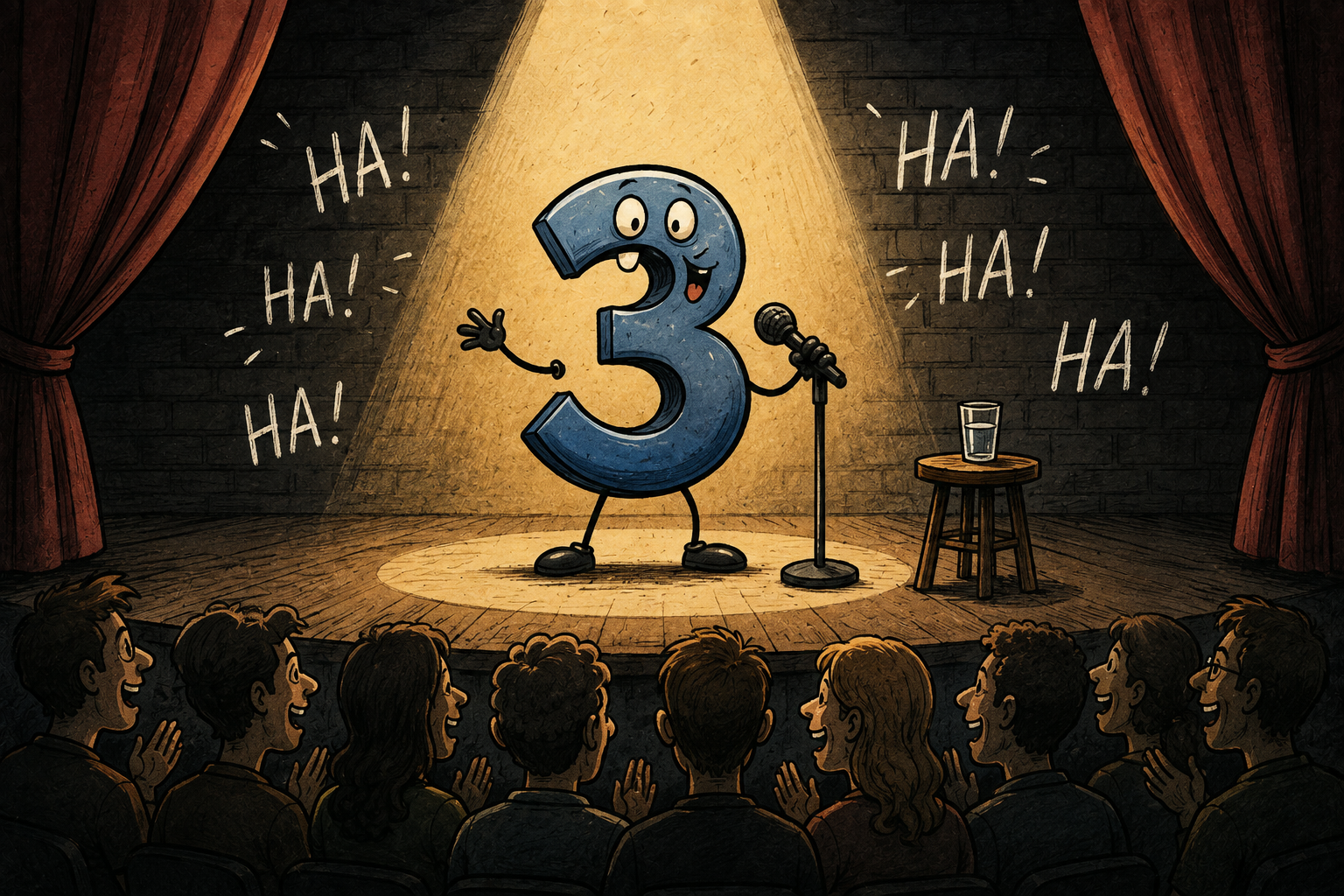
Consider someone who wants to become a comedian. Part of what may distinguish him is deeply personal: his nature, his life experience, and his particular interpretation of life. That may be his prime, but it isn't yet comedy that people will pay to see.
Turning it into that requires composition. A stand-up comedian needs to learn how to write and tell a joke, develop timing, reference earlier material, build a set and read a room. Then come all the less distinctive but necessary parts: marketing, selling tickets, accounting and everything else required to turn a unique perspective into something people can actually consume. It also takes exposure and bravery: putting something personal in front of strangers, pushing boundaries, failing publicly and sometimes paying a personal price for doing so.
The prime doesn't replace any of this. It gives the composition something distinctive to multiply.
And there is an interesting consequence. Imagine narrowing the entire world down to just one activity: making people laugh. Even within that tiny space, there isn't one ideal comedian or a finite collection of valuable ways to be funny. Different lives, perspectives, cultures, observations and forms of expression can keep producing new ways to make people laugh.
Now expand the space again, from comedy to everything we might create, discover, teach, build or provide to one another. This leads to the second claim:
Scale: The space for new value is not finite. There are infinitely many potential primitives, and infinitely many ways for them to participate in new compositions.
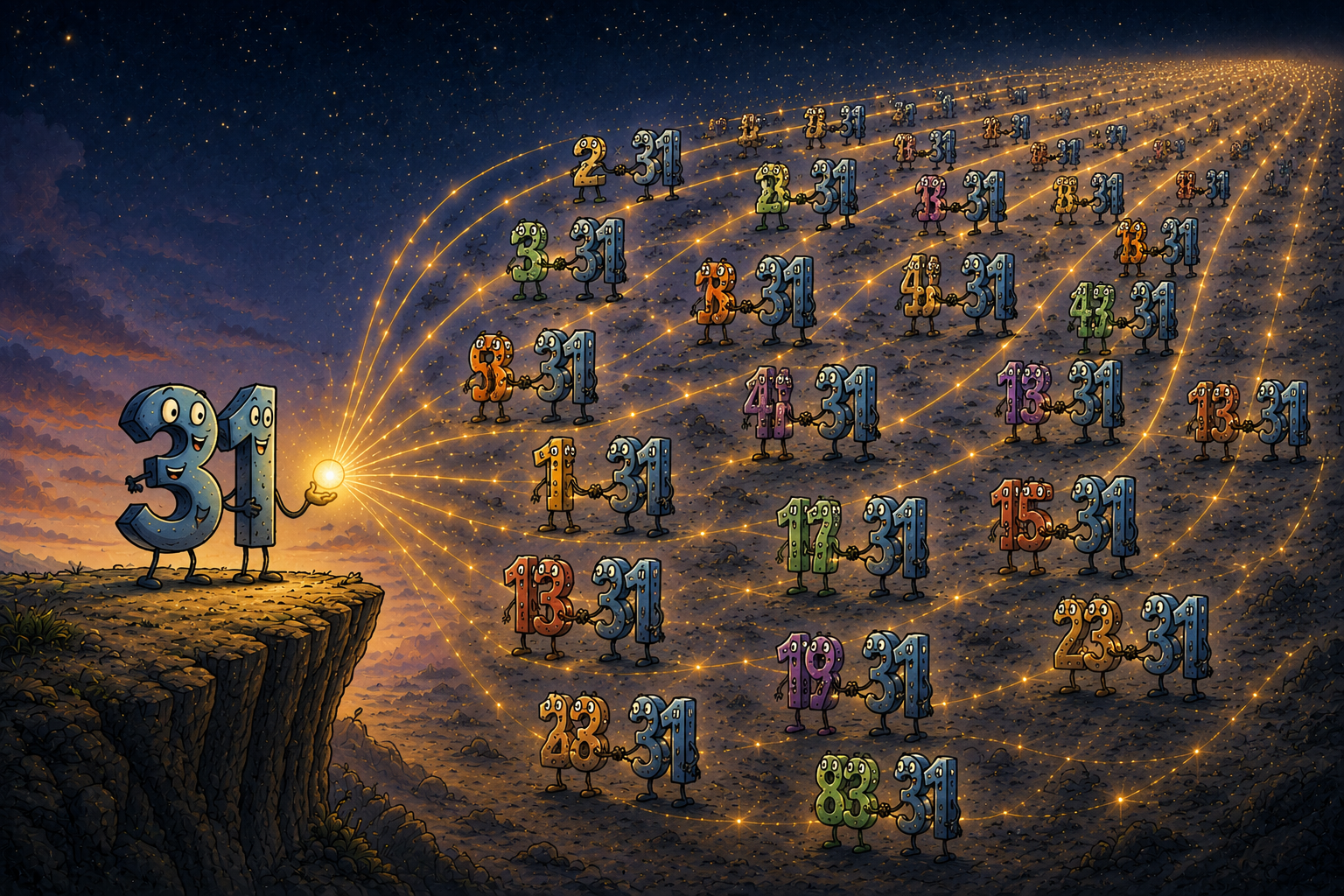
Prime numbers give us a useful illustration. Introduce 31, and you don't just add one number. It can participate in 62, 93, 155, 186..., and infinitely many other compositions. Each new prime adds possibilities by combining with what already exists.
The same applies to the primitives we introduce into life. A new insight, method, capability or form of expression can become part of outcomes its creator never imagined, combined with building blocks created by people he may never meet. We don't need to create every outcome ourselves; we can contribute something that others, including technology, can build upon.
But an infinite space also contains infinitely many things of no particular value. Being different is easy; being different in a way that matters is much harder. This leads to the third claim:
Usefulness: There are infinitely many unique things we can create that nobody needs.
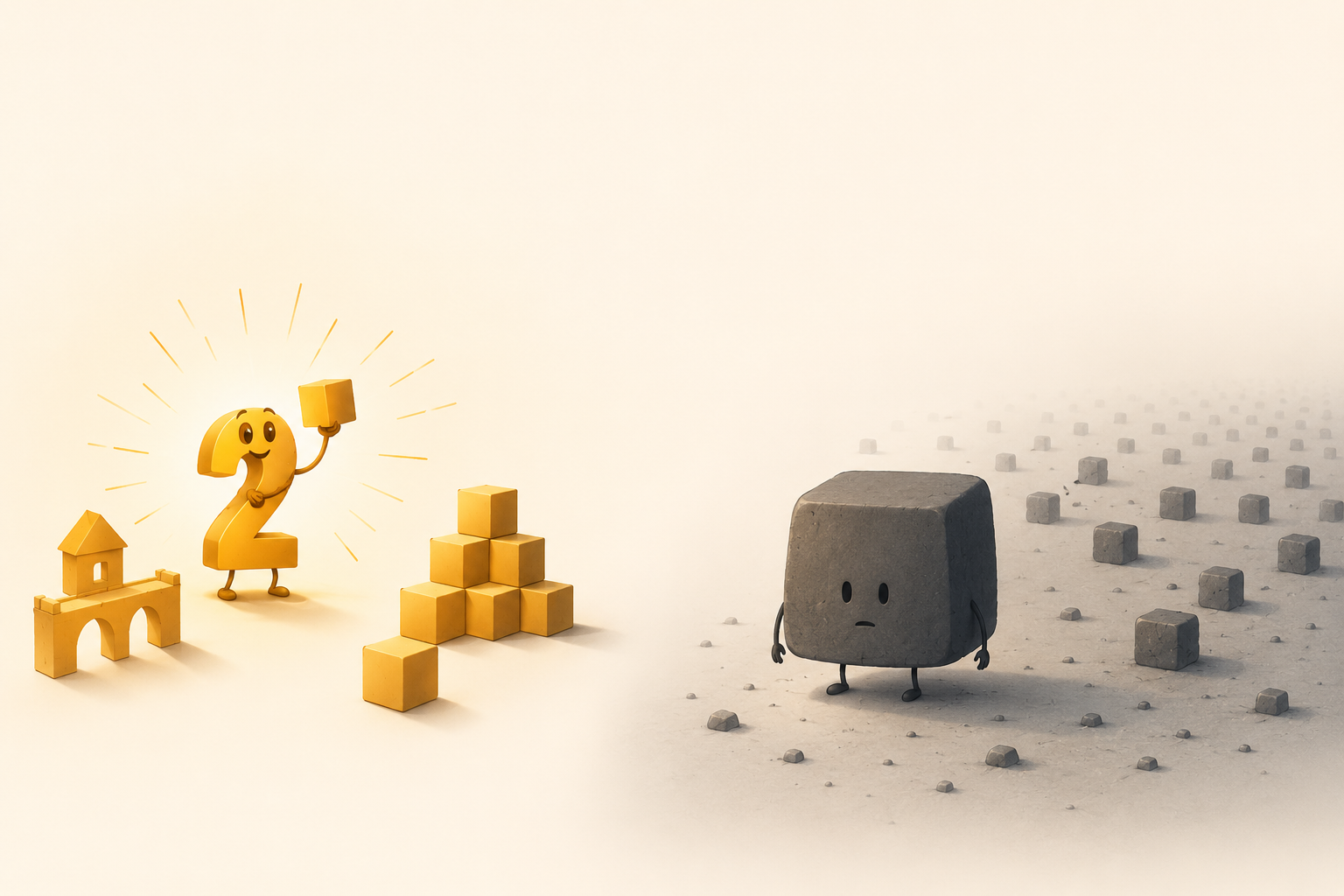
Imagine being the person who introduced 2 to humanity. Its value would be extraordinary because of how much can be built with it. Now compare that with 2¹³⁶,²⁷⁹,⁸⁴¹ − 1, the largest prime currently known, with more than 41 million digits. Both are equally prime, but their usefulness as building blocks in our world could hardly be more different.
The same applies to us. We can be original in infinitely many ways, but originality itself is not the objective. The challenge is to discover something that genuinely comes from us and has value once it enters the world.
Unique is not enough. The prime has to be useful, either by itself or through its combinations with other primes.
There is a consequence to all those possible compositions that we don't need mathematics to observe. We are already living inside it.
Open almost any news or social feed. More articles, posts, images, videos, opinions and variations can be produced than anyone could possibly consume. Some are valuable, many are not, and they all compete for the same limited attention. When composition becomes cheap, we don't only get more value. We get vastly more of everything.
This leads to the fourth claim:
Attention: As composition becomes abundant, signal-to-noise becomes one of the central problems, both for what we consume and for what we create.

The problem works in both directions. As consumers, finding the valuable 31 becomes harder when it is surrounded by millions of variations of what already exists. As creators, even if we have something valuable to contribute, it enters the same crowded space and has to be recognised among everything else.
There is an uncomfortable feedback loop here. When it becomes harder to be noticed, the natural response is to produce more, publish more and appear more often. I may be contributing to it simply by publishing this article.
We are creating an extraordinary amount of cognitive pollution.
Producing another composition simply because we can is therefore becoming less interesting. The ability to recognise signal, and to create something with enough signal to deserve someone else's attention, becomes more valuable.
But even the language of “a prime” is hiding something. Nobody actually produces a perfect 3.
The number is only a representation. In reality, one person may produce something closer to 3.1, another 2.8. The same person may produce an exceptional version one day and a mediocre one the next. One may be precise but slow, another fast but inconsistent. What looks like the same building block from a distance can contain important differences when we look closely.
This leads to the fifth claim:
Quality: Before we can consistently produce a valuable primitive, we need to learn to recognise the qualities that define an exceptional version of it.
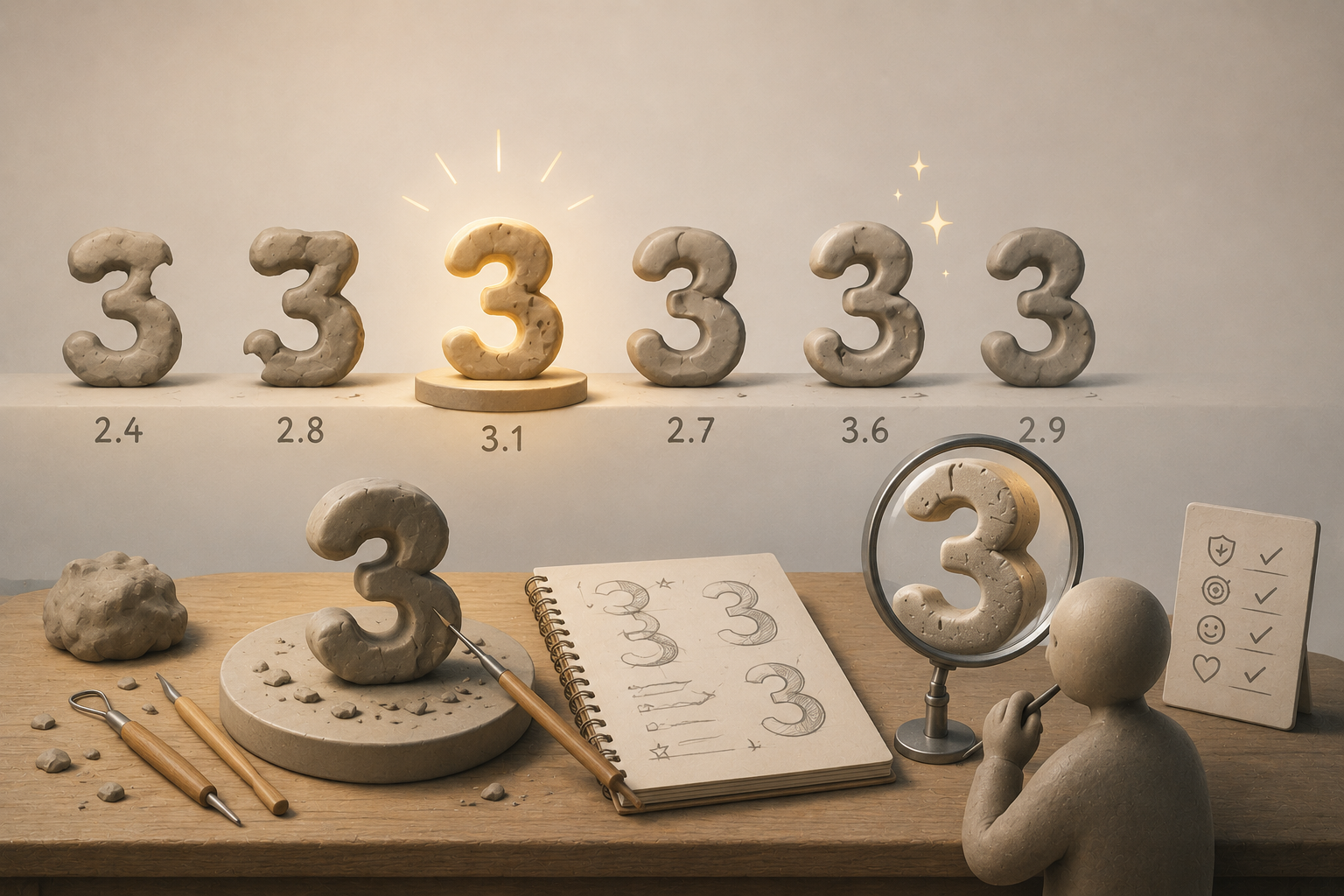
Think again about the comedian. Recognising that his interpretation of life is distinctive doesn't make him a great comedian. He needs to become sensitive to the subtleties of how that prime is expressed: which observations are genuinely his, which are merely unusual, where a joke becomes predictable, how far to push it, and when something that feels funny to him actually connects with other people.
Before generating a great 3, we need to become good at recognising the qualities of a 3.
This distinction becomes more important, not less, when acceptable compositions are easy to produce. “Good enough” becomes abundant. The ability to recognise and produce subtle differences in quality becomes a source of value.
That raises a more personal question: how do we know which primes we are capable of producing in the first place?
We tend to describe ourselves through outcomes and roles: engineer, manager, comedian, teacher, entrepreneur, designer. But those are often compositions. The more interesting clues may be the factors that repeatedly appear underneath them.
Suppose that across very different parts of your life you keep producing 6, 9, 12, 24.... Perhaps you thought those outcomes were unrelated, but they all contain a 3. Maybe the thing worth understanding is not any particular result, but your unusual ability to generate that 3.
This leads to the sixth claim:
Discovery: Look for the primitives you can produce naturally and repeatedly, then ask where they become useful, either directly or through composition.
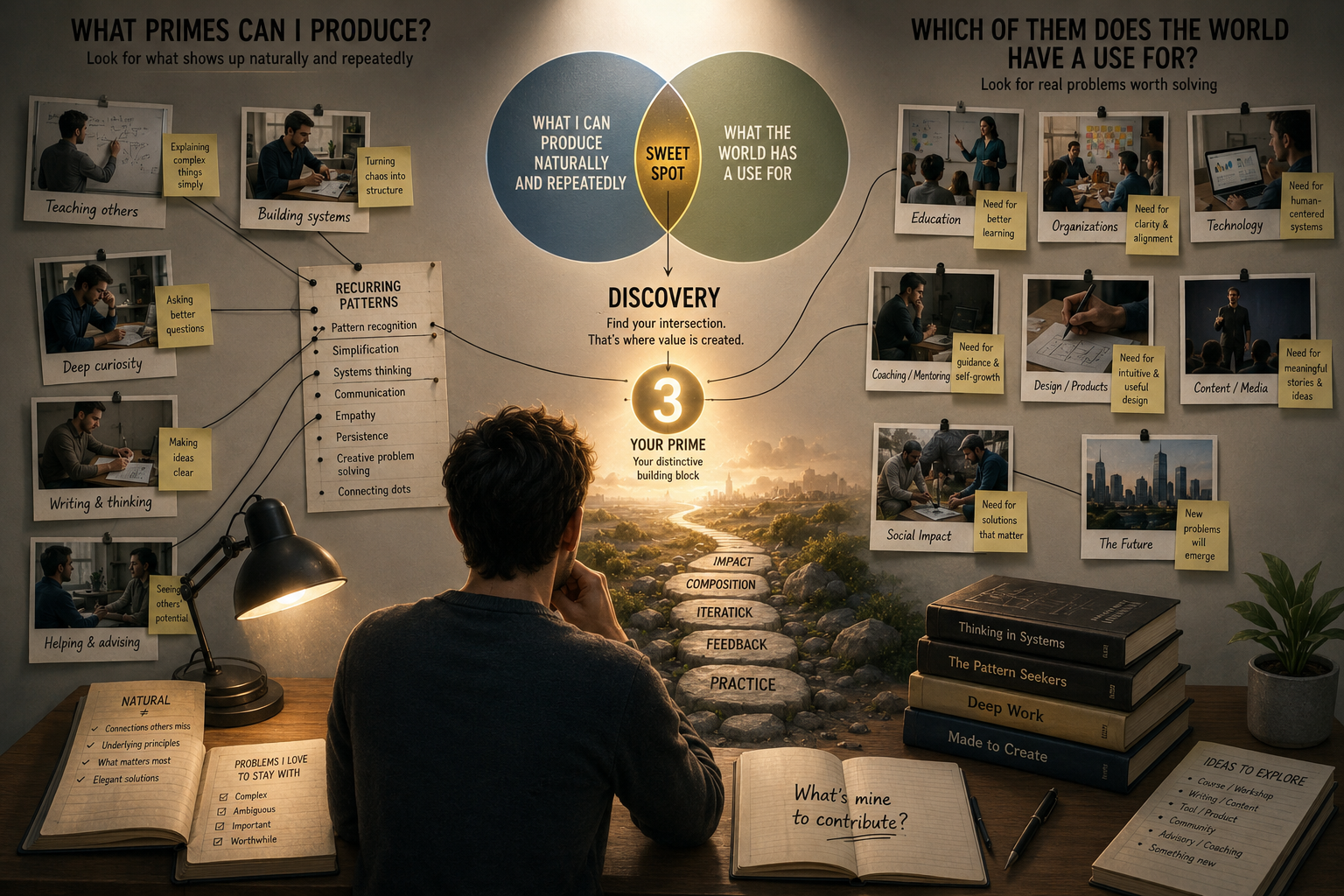
“Natural” doesn't mean effortless. Some of the things we are best at took years of work to develop. I mean something closer to a recurring fit between our nature, experience and capability: work we return to, distinctions we notice that others miss, problems we enjoy staying with, or outcomes that keep appearing across otherwise unrelated parts of our lives.
There are two questions here:
What primes can I produce?
Which of them does the world have a use for?
The intersection is what we are looking for.
There is a limitation, however, in discovering ourselves only from what we have already done. If we stay in the same environment, work with the same people and solve the same kinds of problems, we only observe ourselves under a narrow set of conditions. We may become exceptionally good at producing 30 without ever discovering the 31 next to it.
This leads to the seventh claim:
Exploration: New environments can reveal primitives that familiar ones never expose.
This is a more useful reason to step outside a comfort zone than discomfort for its own sake. Exposure creates information. Work with people who think differently. Enter a field where your existing expertise doesn't immediately solve the problem. Build something you don't know how to build. Put an unfinished thought in front of people who may reject it.
Some experiences will confirm what we already know. Others will show that something we thought was ours was largely a product of the environment around us. And occasionally, a situation we would never have chosen for efficiency reveals something we didn't know we could produce.
Exploration expands the conditions under which we get to observe ourselves.
And here we run into one of the stranger paradoxes of the current shift.
The same technology that makes composition cheap also makes it possible to skip much of the process that used to produce an outcome. If the outcome is all we care about, that is wonderful. But sometimes the process was producing something else at the same time: us.
Reading a difficult paper produces more than a summary of the paper. Writing produces more than text. Solving a problem produces more than its answer. Building something badly for the first time may produce little immediate value, but it changes the person building it.
This leads to the eighth claim:
Training: We need to distinguish between processes we perform for their output and processes we perform because going through them develops new primitives in us.
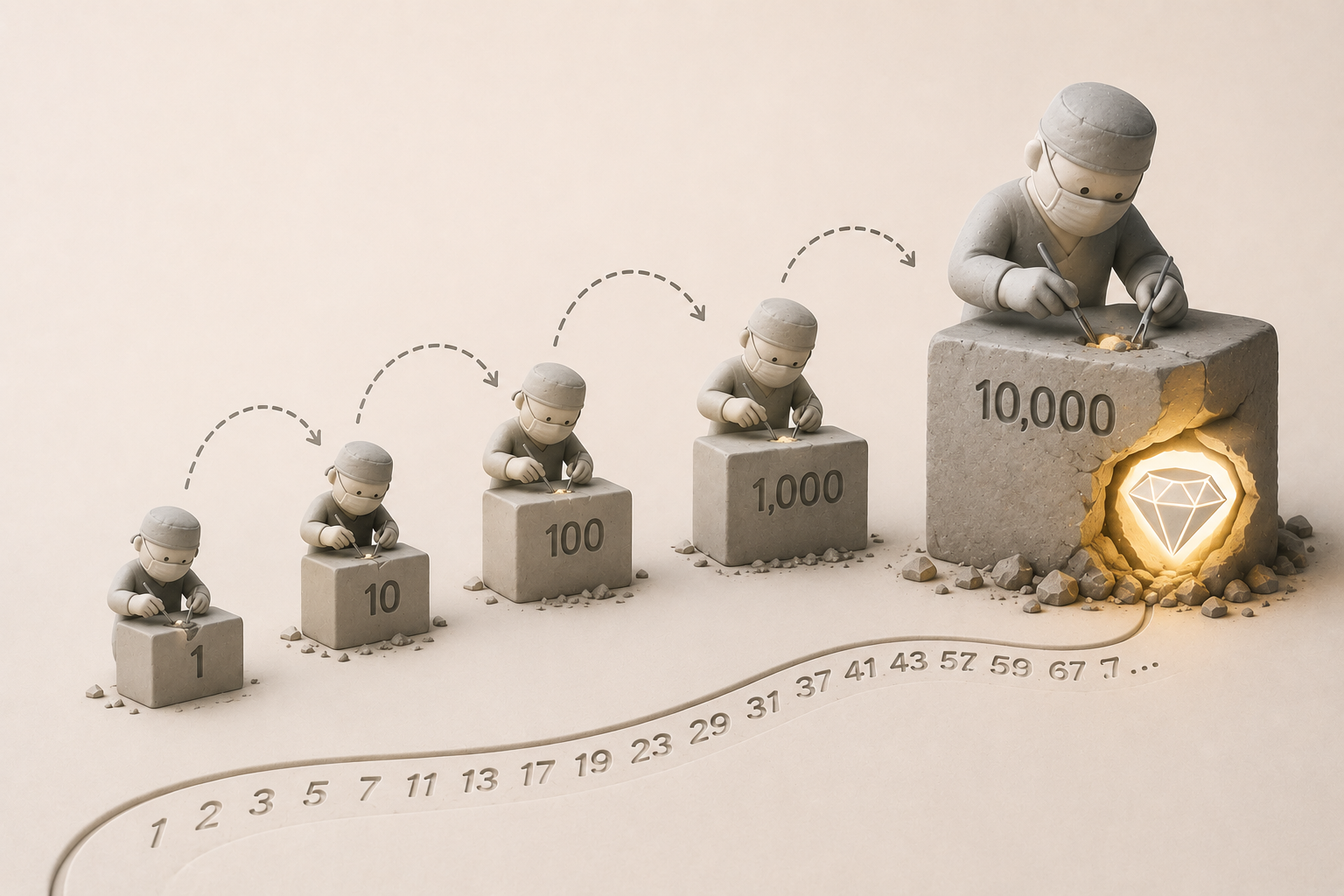
This creates a paradox. We have stronger tools than ever for avoiding difficult cognitive work, at exactly the time when differentiated thinking may become more valuable.
I have no interest in preserving unnecessary work. If technology can remove three hours of mechanical effort, take the three hours. But if the struggle itself develops judgment, taste, intuition or a capability we don't yet have, delegating it may save the work while removing part of the learning.
So the question is no longer simply:
Can I delegate this?
It is also:
What happens to me if I do?
Eventually, however, something valuable that exists only inside us reaches a limit.
A surgeon can develop intuition after thousands of procedures. A founder can sense that something is wrong in an organization before being able to explain why. A craftsman may make dozens of tiny decisions that never appear in the final description of his work. Years of experience can become compressed into judgment that is extremely valuable and almost invisible.
But technology cannot compose what it cannot access.
This leads to the ninth claim:
Articulation: A useful prime gains leverage when we can give it a representation that allows others, including technology, to work with it.
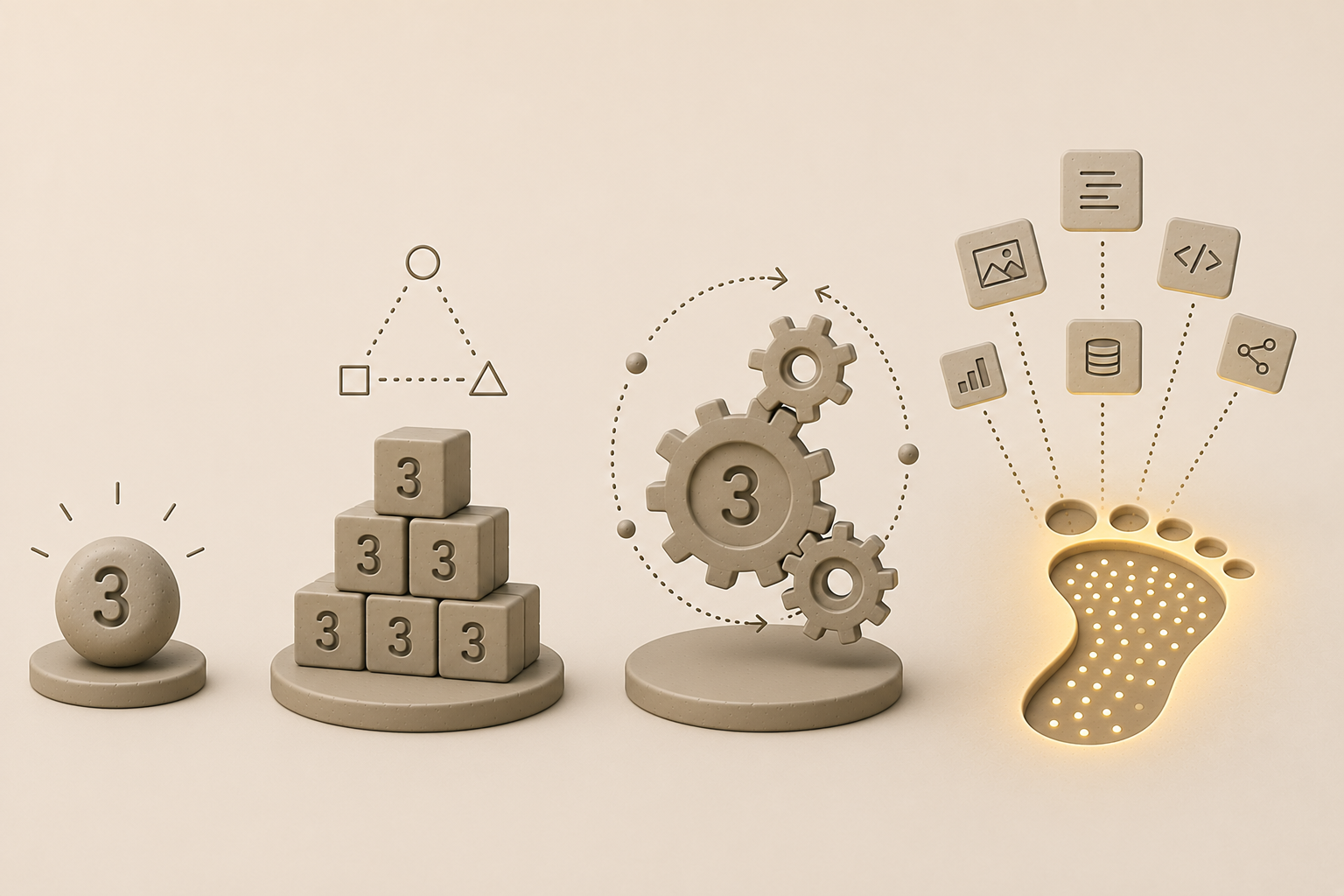
That representation doesn't need to capture everything. It probably never will. The number 3 in our illustration was never the thing itself; it was a representation of something richer.
The challenge is to make enough of the implicit explicit.
An intuition can become an explanation. An explanation can become a method. A method can become a process. A process can become software. Experience can become words, examples, decisions, data or systems.
This is what I mean by creating a digital footprint. Not documenting our lives for the sake of producing more content, but representing something valuable well enough that it can enter the compositional world.
And now we can close the loop.
We started with a world of primitives and multiplication. For most of our history, we had to invest heavily in both. We had to discover or create the building blocks, and then spend enormous effort composing them into useful outcomes.
The economics of the second part are changing.
This leads to the final claim:
Leverage: Don't compete with multiplication. Give it better things to multiply.

Discover the primitives that genuinely come from you. Understand which are useful. Learn the subtleties that distinguish an exceptional version from an average one. Expose yourself to enough of life to discover new ones. Do the work that develops them, articulate them, and give the valuable ones a digital footprint.
Then let technology do what it is becoming extraordinarily good at doing: compose.
The future of work, from this perspective, is not a competition between people and technology over who can produce more outcomes. It is a shift in where we should invest our effort as the economics of producing those outcomes changes.
We spent much of our history doing both: creating the building blocks and performing the multiplication.
We are increasingly getting the multiplication for free.
So keep looking for primes.